

For organizations that use a distributed workforce model — especially when those workers are operating in very remote or harsh environments — traditional castle-and-moat cybersecurity models are no longer enough to prevent the growing number of cybersecurity threats faced by government agencies and critical infrastructure providers today. The growing threat landscape is quickly changing the way such organizations think about endpoint and network security.
Staying safe, protected, and compliant now involves much more than simply monitoring network activity or protecting data in transit. Devices themselves must also be secured to mitigate the risk of a bad actor using a compromised or stolen device to gain access to proprietary data and systems.
While utility field service technicians, military units, law enforcement precincts, federal agencies, and other frequently deployed roles have relied on rugged laptops and rugged tablets for years due to the strenuous operating conditions of these roles, rugged devices have now become much more than a durable piece of hardware that can survive a drop or spill. It is essential that IT leaders at these organizations choose rugged solutions that can contribute to a larger cybersecurity strategy and form the foundation for data protection at the edge.
Understanding the Expanding Attack Surface at the Edge
Field work has long been a component of operations for many public and private organizations. However, the shift toward digital transformation in recent years has caused the attack surface to expand rapidly for agencies and enterprises. Field teams now rely heavily on their mobile equipment to give them continuous access to databases, schematics, geographic information systems (GIS), work orders, and much more.
When this information gets accessed through public or unsecured networks — or when devices go offline entirely — a variety of risks can get introduced. For example:
- If a device is stolen or lost in the field, data at rest might be at risk of loss or interception.
- If devices come under attack by malware, firmware attacks, or compromised components, network-based cloud security may not be accessible to defend them.
- Compromised mobile devices can perpetuate threats into other endpoints they access, such as IoT sensors and older infrastructure that can only be interfaced with via USB or other hardwired connections.
The need for secure remote access has never been greater in a digital age defined by threats like ransomware, malware, and firmware vulnerabilities. Field teams need to access systems, upgrade records, file reports, and communicate in real time from anywhere. Enabling this productivity without introducing added risk requires thinking of endpoint security as a core component of security, not an add-on.

What is Endpoint Security?
At its simplest, endpoint security refers to efforts to enact cybersecurity defenses that protect devices such as laptops, tablets, handhelds (such as cell phones), IoT sensors, and any other devices that connect to an organization’s network. While once an afterthought, endpoint security is now critical for any entity running these types of devices at remote sites or during field operations.
Modern endpoint security solutions need to do more than detect or block threats. They must also be able to:
- Collect and analyze real-time threat intelligence data to identify anomalies as they happen.
- Report and prevent unauthorized changes at the hardware and firmware level.
- Facilitate rapid incident response, even when devices are disconnected from an enterprise network.
- Integrate seamlessly with other network security layers and systems.
- Hardware-level validation/protection
- OS and application security
- Network monitoring and identity/access verification
- Visibility tools that facilitate up-to-date compliance
Endpoint security is virtually the first — and sometimes the only — line of defense for devices deployed in frontline operations. If a device gets compromised before it reconnects to a trusted network, downstream protection solutions may not be able to fully mitigate the risks imposed. For this reason, more organizations are increasingly prioritizing endpoint security protection that begins below the OS and extends across the full device lifecycle, from initial kitting and deployment through eventual end of service and recycling.
Bringing a Layered Approach to Enterprise Cybersecurity
Unfortunately, no single security solution can address all of the varying types of threats faced by today’s frontline workforce. As such, leading organizations are moving toward a layered security approach by building multiple defenses that work together to provide end-to-end protection.
In practice, this means combining solutions that offer:
The redundancy offered by these layers ensures that threats are still detected and contained even if they make it past another security layer. For field agents and technicians, especially, a layered model must also function independently of connectivity. Even if devices can’t get input, feedback, and protection from a central network, they still need to enforce policies, validate integrity, and protect data.
However, bolting together disparate solutions still may not offer full protection, as different solutions providers may have conflicting priorities and functionality built into their tools. For this reason, Panasonic Connect has developed TOUGHBOOK® Total Defense, which offers layers of security working in tandem to ensure total protection.
Security From the BIOS to the Edge With TOUGHBOOK
The TOUGHBOOK Total Defense platform takes a unique approach to cybersecurity. It starts at the lowest layer of the device and builds protection upward.
Instead of relying on external controls to force solutions to work together, TOUGHBOOK integrates endpoint security solutions directly into the hardware and firmware, ensuring a secure foundation for everything else running on top of it. Total Defense offers multiple layers of protection, including:
Hardware and Firmware Security
Security starts before the operating system is allowed to load. That way, if a compromised component has somehow been implemented into the device, built-in protections exist to identify tampering before it can create issues. This protection is especially important for compliance with security frameworks like NIST and CJIS, which emphasize firmware-level security.
Continuous Monitoring and Compliance
Through a series of integrated tools and partnerships, TOUGHBOOK rugged laptops and 2-in-1s provide constant visibility into system health, potential vulnerabilities, and compliance status. This posture enables organizations to be more proactive about cybersecurity risks instead of reacting once the damage has been done.
AI-Powered Threat Detection
Using artificial intelligence, Total Defense helps detect and prevent threats in real time, helping to ensure suspicious behavior or outright attacks are addressed before they can spread into the wider system. For field operations, delayed detection can often lead to significant operational and financial setbacks, making this ability especially critical.
Ongoing Resilience
One of the most important capabilities offered by the TOUGHBOOK approach is the way it maintains protection even when devices are offline. From compliance and policy enforcement to data at rest protection, TOUGHBOOK devices stay secure regardless of location or connectivity status.
Unified Endpoint Security Management
Mobile device networks have an increased level of complexity by default, which can be difficult for some IT teams to manage with limited resources. Additional support from TOUGHBOOK Professional Services gives IT teams the tools and bandwidth necessary to manage device networks and enforce policies in a centralized way. For example, devices can be deployed and updated remotely, health and usage can be monitored in real time, and threat response can happen quickly from a central hub instead of bouncing between tools trying to find the right one for the problem.

Redefining Endpoint Security for a Distributed Workforce
As organizations process more data and conduct more operations at the edge, network security definitions must evolve alongside the actual work. Protecting centralized systems and assuming endpoints will follow suit is no longer good enough. The devices themselves must also be secured, preferably by design.
TOUGHBOOK rugged laptops, 2-in-1s, and Honeywell rugged handhelds* are uniquely positioned to meet this need thanks to TOUGHBOOK Total Defense, which offers layered security from the BIOS to the edge. Security extends from the head office and the data center out into the field, providing a resilient and effective security posture.
Learn more about TOUGHBOOK Total Defense and how it can protect your organization wherever the work needs to happen.
*Not all components of TOUGHBOOK Total Defense are compatible with Honeywell rugged handhelds.
Looking For More?
-
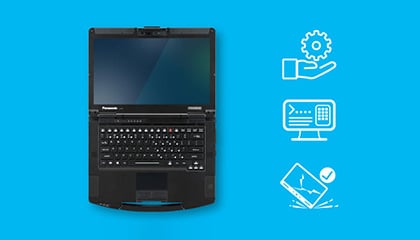
TOUGHBOOK Solutions
-
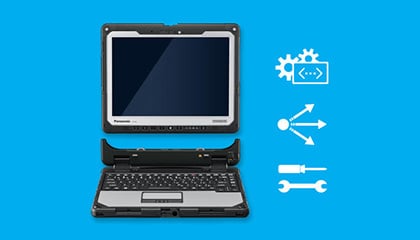
TOUGHBOOK Services
-

Rugged Laptops & Tablets