

Battlefield medicine moves at a pace and scale that would have been difficult to imagine even a decade ago. Medical teams need the ability to triage patients rapidly, document care in real time, and coordinate across dispersed units, often while under high operational pressure as well as significant physical and emotional strain. Speed and mobility are essential to operational success.
Rugged laptops play a critical role in a military field hospital because there is no room for technology failures. A device that freezes, loses power, or fails to connect can delay treatment, disrupt communication, or put lives at risk.
To operate effectively, frontline medical personnel need tools that support rapid triage in high-stakes situations, provide access to real-time patient records, and facilitate coordination of care across units and command structures. To this end, durable and secure mobile computing power has become a foundational element of battlefield medicine.
Rugged Laptops Serve Medical Personnel in the Harshest Environments
Rugged devices have evolved alongside modern military operations, supporting a wide range of military use cases across combat support hospitals, evacuation units, and humanitarian missions. Unlike consumer-grade computers, rugged laptops and rugged tablets are built specifically for use in environments where instability is the norm.
In dynamic military medical settings, reliable laptop performance offers a significant advantage in efficiency and patient care. Lightweight designs, long battery life, and hot-swappable batteries allow military medical personnel to move freely without being tethered to wall outlets or bulky workstations. In settings where electricity is inconsistent or unavailable, this capability alone can mean the difference between uninterrupted care and operational disruption.
Connectivity is equally important. Field hospitals often operate in low-bandwidth or disconnected environments, but they still require access to military communications systems, databases, and networks. Rugged laptops are engineered to maintain stable connections across multiple network options, enabling teams to share data and coordinate care even under constrained conditions.
Their flexibility and modularity make them even more useful to military medical units. Rugged laptops can be:
- Mounted in vehicles for mobile care
- Used bedside in temporary treatment areas
- Integrated into command centers for operational coordination
Unfortunately, consumer-grade devices are prone to failure in these environments. Ports clog with dust, batteries degrade quickly under temperature extremes, screens crack under impact, components fail under vibration from rough roads, and cooling systems struggle in high-heat conditions. Adding these types of vulnerabilities to already complex operations creates unnecessary risk for both patients and medical personnel.
Conversely, purpose-built rugged laptops are engineered to withstand:
- Extreme heat and freezing temperatures
- Dust, sand, and water exposure
- Drops, shocks, and sustained vibration
As a result, doctors, nurses, and other military medical professionals get consistent performance, reducing downtime and minimizing the need for replacements or repairs in the field.
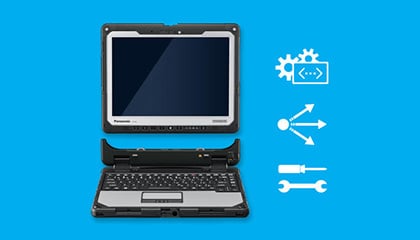
Panasonic TOUGHBOOK® devices exemplify this approach. Designed to meet MIL-Spec durability standards, they are engineered for environments where users cannot afford failure. That reliability translates into lower lifecycle costs and greater operational continuity, both of which are essential in high-stakes deployments.

Enabling Real-Time Patient Care, Triage, and Data Capture
In a military field hospital, rugged laptops function as far more than communication tools. They serve as mobile clinical workstations that sit at the center of care delivery for injured troops. Field medics, nurses, and doctors all rely on these systems to support a range of critical workflows, including:
- Digital triage
- Patient tracking
- Scanning barcodes for medications and supplies
- Accessing and updating electronic health records (EHRs)
These capabilities enable medical staff to make faster, more informed decisions. Instead of relying on handwritten notes or delayed data entry, teams can document care as it happens, reducing errors and improving the continuity of care from the point of injury through evacuation and treatment.
The impact becomes especially clear during high-pressure scenarios. In events with significant casualties, rugged laptops let medical teams track patients across multiple treatment stations, update statuses in real time, and ensure no critical information is lost in the chaos.
During evacuations, clinicians can update patient records on the go so the teams awaiting the patients have immediate visibility into condition, treatment history, and next steps. This ability significantly reduces handoff errors and accelerates treatment upon arrival.
Rugged laptops also act as integration hubs for portable medical diagnostics, including:
- Ultrasounds
- ECGs
- Patient monitoring devices
- Imaging systems
- Diagnostic equipment
By integrating this equipment into field operations, better care happens closer to the point of injury. Instead of waiting for patients to reach fully equipped hospitals, medics, nurses, and doctors can perform diagnostics in the field and begin treatment earlier.
Telemedicine further expands what’s possible. With rugged laptops and tablets, field teams can connect with specialists remotely for diagnosis and decision-making, even in remote deployments, naval operations, or disaster response situations. This ability is driving a fundamental shift in how care is delivered. Advanced medical capabilities move with the patient, reducing time to treatment and improving outcomes.
The Operational and Financial Case for Rugged Laptops
While the clinical benefits of rugged laptops are clear, the operational and financial case is just as compelling. From a total cost of ownership perspective, military rugged laptops and tablets consistently outperform consumer- or business-grade alternatives. They last longer, require fewer repairs, and experience significantly less downtime. For organizations that operate regularly in environments where replacing or repairing devices is logistically challenging, this durability becomes a major benefit.
Beyond simple durability, rugged laptops improve operational efficiency. Medical teams can move faster, rely on consistent performance, and avoid the manual workarounds that often arise when technology fails. Over time, these efficiencies compound, enabling better resource utilization and more effective care delivery.
Military cybersecurity is another key consideration. Field hospitals handle sensitive patient data that must be protected, even when it is collected or recorded in disconnected or contested environments. Compliance with DHA and HIPAA standards is non-negotiable.
Panasonic TOUGHBOOK Total Defense addresses this challenge through a layered security approach that protects devices at every level:
- Hardware and firmware integrity verification before the system boots
- Continuous monitoring for unauthorized changes or vulnerabilities
- Endpoint resilience that maintains control even off-network
- AI-driven threat detection and automated response
This approach is particularly important in combat environments, where devices may operate outside the protection of traditional network perimeters. By embedding security directly into the device, TOUGHBOOK ensures that protection remains active regardless of connectivity.
When viewed holistically, ruggedization is a strategic investment in operational resilience. It reduces risk, improves efficiency, and supports the consistent delivery of care in some of the most demanding environments imaginable.
Military Technology That Matches the Mission
Military medical teams are asked to deliver high-quality care in environments that challenge both people and equipment at every turn. In this context, rugged tablets and laptops become an essential tool for mission success. They enable real-time care, support critical decision-making, and provide the reliability that frontline teams depend on when lives are at stake.
Panasonic TOUGHBOOK brings together durability, mobility, and advanced security in a single platform designed for these realities. From battlefield medicine to humanitarian response, rugged mobility solutions from Panasonic Connect equip medical teams with technology that works as hard as they do.
Learn how Panasonic TOUGHBOOK can support military healthcare operations.
Looking For More?
-

EMS Solutions
-
TOUGHBOOK Services
-

Rugged Laptops & Tablets