

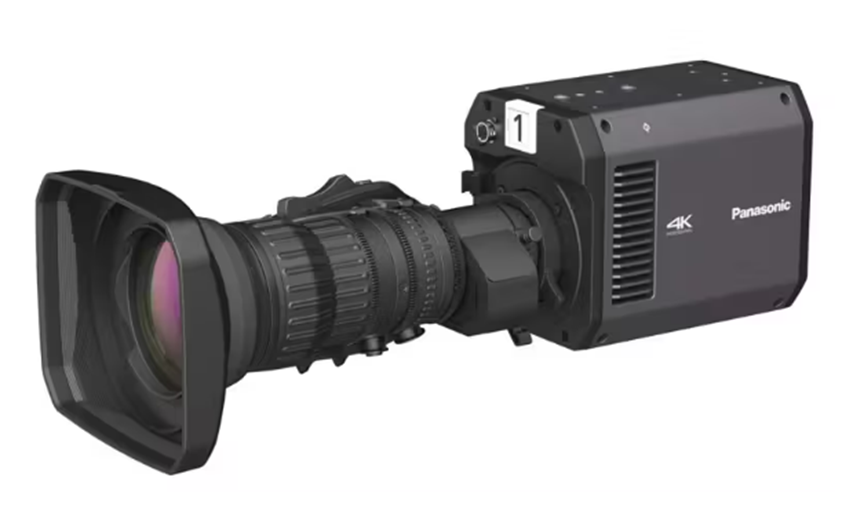
Creating an immersive experience on an LED stage demands sharp focus — both creatively and technically. Traditionally, studio camera operators have had to rely on manual lens adjustments. Panasonic recently changed that with the debut of the world’s first auto-focus (AF) capability for 4K studio cameras.
This breakthrough is now available as a firmware update for the flagship AK-UCX100, enhancing a camera already trusted for studio, sports, and live event production. The newly announced AK-UBX100 box-style camera follows suit, with AF functionality arriving via firmware in Q2 2026.
How Live Production is Evolving
AF is becoming a more important AV tech feature as live production evolves with LED walls, immersive 4K projector technology, and sophisticated lighting. There's also a growing market for live streaming. Demand for immersive experiences impacts everything from concert broadcasts to business collaboration, visual learning, and sports event production.
Visual focus is particularly tricky in these AV technology environments. For example, LED panels risk moiré patterning when individual emitters become visible at high F-numbers and long focal lengths. Complex lighting setups and digital projectors only compound the problem.
There's also a coordination challenge. Multi-camera workflows in audiovisual technology environments demand precise alignment between focus, tracking, and on-screen content. Broadcasters are experimenting with multi-camera operation, including using point-tilt-zoom cameras with LED backgrounds. However, speed and accuracy have been sticking points. Any audiovisual technology that can take visual focus decisions off a busy operator's plate without sacrificing image quality looks increasingly attractive.
How Panasonic's Studio Cameras With Autofocus Work
Panasonic's AF technology relies on phase detection autofocus, (PDAF). It allows the 4K camera to focus on subjects quickly and accurately regardless of the lens type. That's important for crews who are swapping glass mid-shoot or working with rental inventory they've never touched before.
A mirror splits light passing through the lens into two paths, directing it to a dedicated distance-measuring sensor that's separate from the main image sensor. The scanner removes the need to guess at focus by analyzing the picture itself, which can cause AF to hunt or drift in tricky lighting. PDAF's dedicated sensor measurement creates fast, stable acquisition across a wide variety of lenses.
Panasonic has built flexibility into its AF system. AF Area Select lets operators select the target area from nine different areas. They can also adjust the position, size, and speed of the target area.
Impact on Immersive Experience Workflows and Operators
While a veteran focus puller can still rely on their own eye, AF assists less experienced crew members who are slower on the ring. That matters when budgets are tight and productions can't always staff up with specialists.
It's also a big help with remote workflows, where cameras sit at a venue while operators and directors work from a centralized hub miles away. Pulling focus remotely is difficult with latency in the loop and no physical feel for the lens, making AF an increasingly important part of remote audio visual solutions.
Additional December 2025 Firmware Enhancements
While auto focus grabs headlines, Panasonic's firmware update brings several additional enhancements designed with production teams in mind – especially those working under tight schedules to create immersive experiences.
For sports and action shooters, Low Skew Mode significantly improves image stability in fast-motion scenes. Rolling shutter artifacts (that unwelcome ripple when the camera pans quickly) can ruin otherwise gorgeous footage. This mode tamps that down.
On the connectivity front, look for expanded Video TRUNK functionality with 12G-SDI support, opening up high-bandwidth signal transmission for facilities that need to push uncompressed 4K over longer cable runs. That's increasingly relevant as AV tech infrastructure scales up to handle LED volumes and multicamera live production.
Two quieter additions round out the update. Automatic correction for F-drop and peripheral light falloff helps maintain uniform image quality. There are no more vignetting surprises when you stop down or switch lenses. And remote back focus adjustment allows focus to be fine-tuned from a distance. That's another nod to remote workflows where hands-on access to the camera body isn't an option.
Setting a New Standard for Studio Cameras
The AF capability's arrival as a firmware update for cameras in the field reinforces Panasonic's position as a technology partner that continues to take care of its existing customers. In an industry where visual learning, corporate events, and live entertainment all demand sharper images with smaller crews, that kind of future-proofing matters.